Interview integrity
AI interview cheating detection, with the evidence attached.
Know which answers were the candidate’s own before anyone books a second round.
EvoHire’s AI runs the phone or video screen, then flags AI-assisted answers with the signals named.
Up to 20 interviews · No credit card
Record, analyse after the call, report with evidence.
Two in three hiring managers have caught candidates using AI deceptively, according to Greenhouse’s 2025 survey of 1,236 recruiters and hiring managers. Detection is part of every EvoHire interview: no proctoring mode to switch on, nothing for the candidate to install.
- 1Record
EvoHire runs and records the interview
Its AI interviewer asks your approved questions by phone or video and records every answer with a transcript.
- 2Analyse
Answers are analysed after the interview
It looks at response timing, shifts in delivery, phrasing, similarity to generated answers and the audio itself.
- 3Report
The verdict arrives with its evidence
The verdict and every signal behind it, each tied to the answer it came from.
Four verdicts, and every one shows its work.
Every interview receives exactly one integrity verdict, reported separately from the accuracy grade and the fluency assessment. A strong answer can still be flagged.
- Inconclusive
- The interview did not produce enough usable signal to support a judgement either way.
- Low concern
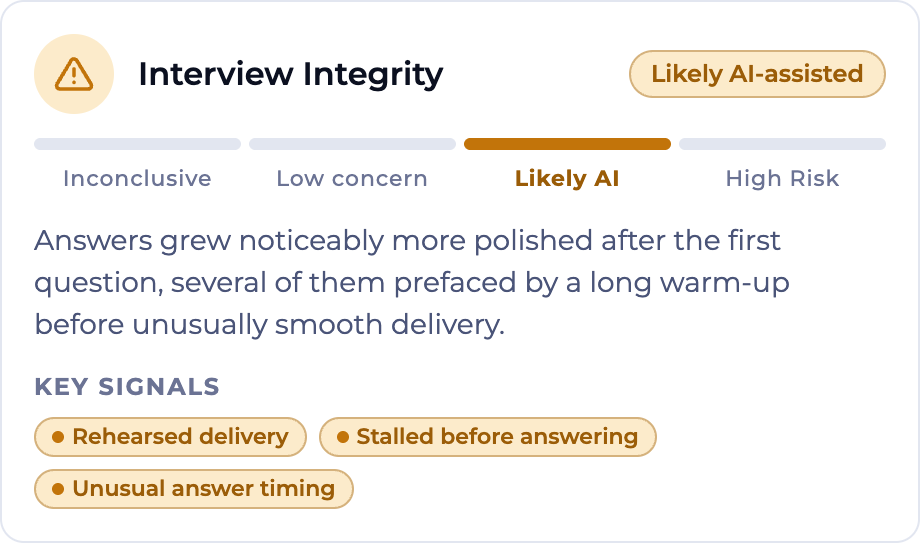
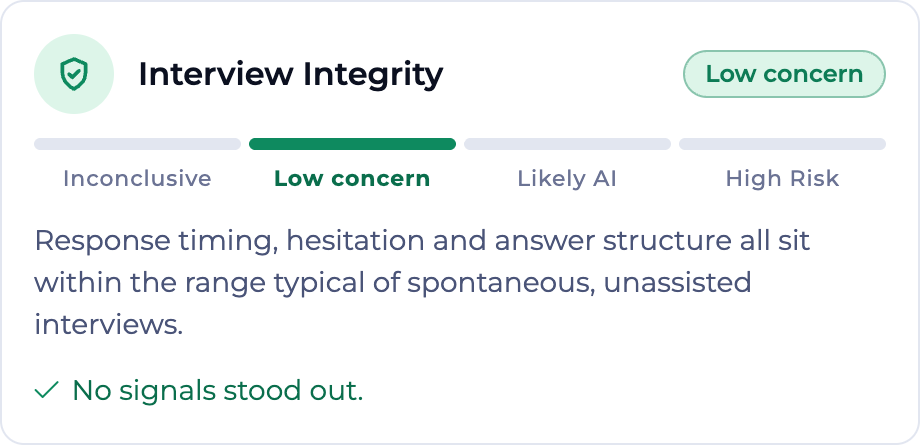
- Timing, hesitation and answer structure look like a spontaneous, unassisted interview. No signals stood out.
- Likely AI-assisted
- Several signals together point to assistance. Review the flagged answers before deciding anything.
- High risk
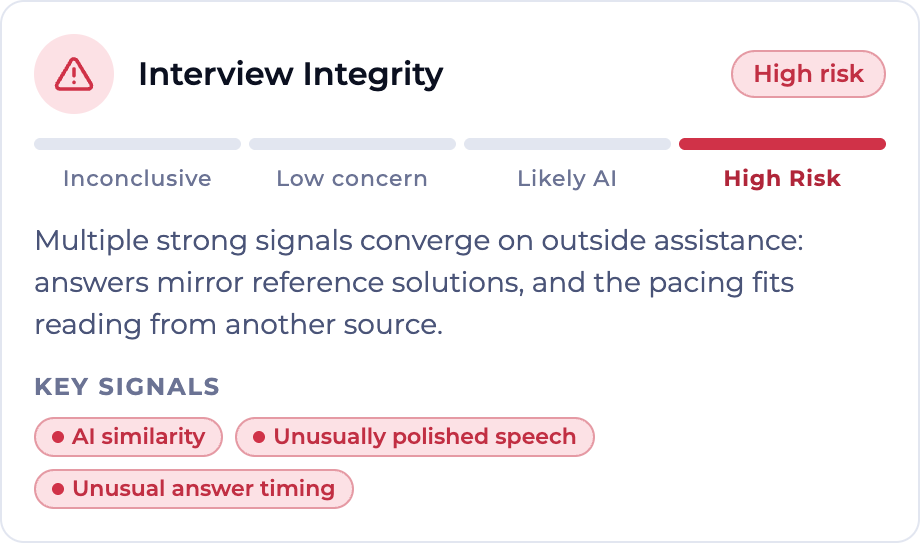
- Strong, converging signals. Start with the flagged answers in the recording before anyone books the next round.
What it flags, and how it stays fair.
EvoHire listens to the answers themselves, so it catches copilots it never sees on screen. That’s also why it works on phone calls.
What it flags
- Stalled before answering. A long, consistent silence before an answer begins, including on easy questions.
- Unusual answer timing. Pause lengths that barely vary with question difficulty, or timing that fits reading from another source.
- Rehearsed delivery. Answers that grow noticeably more polished after a warm-up, then arrive unusually smoothly.
- Unusually polished speech. Textbook phrasing and connectors without the hesitations and self-corrections of spontaneous speech.
- AI similarity. Answers that closely mirror what a public model produces for the same question, across several questions.
How it stays fair
- After the call, never during it. Integrity is assessed from the recording, so the interview runs uninterrupted.
- Your team decides. EvoHire flags. A person reviews the answers and makes the call.
- Nothing to install. Candidates join by phone or in the browser, with no proctoring software to set up.
- Candidates know up front. Every candidate is told the interview is recorded before it starts.
On every plan · No credit card
Questions, answered.
Timing, signals, verdicts, what happens when someone is flagged, and what candidates experience.
Can EvoHire stop AI cheating in interviews?
Yes. EvoHire conducts the first-round interview itself, then checks every answer for stalls, odd timing, rehearsed delivery and AI-like phrasing. If a candidate had help, the interview comes back flagged.
Does EvoHire detect AI use live, during the interview?
No. Integrity is assessed after the interview from the recording and transcript. There is no real-time verdict shown to the candidate, the interviewer, or your team mid-call.
What signals does the integrity analysis use?
EvoHire analyses answer content and response timing after the interview, and the report names the signals it found with the same labels every time: Stalled before answering, Unusual answer timing, Rehearsed delivery, Unusually polished speech, and AI similarity. Because the review follows what was said and how the answer developed, it catches interview copilots, whether an on-screen overlay, an earpiece, or ChatGPT on a second device, with no proctoring software.
What do the four verdicts mean?
Every interview receives one of four integrity verdicts: Inconclusive, Low concern, Likely AI-assisted, or High risk. Inconclusive means there was not enough usable signal to judge either way. Low concern means the signals are consistent with an unassisted answer. Likely AI-assisted means several signals together point to assistance. High risk means the signals are strong and converging. Each verdict is shown with the named signals and the answers they came from.
Will it flag honest candidates?
Not for one long pause or one polished answer. A flag needs several signals pointing the same way, and fluency is scored separately, so an accent isn’t treated as AI help.
Can a high-risk verdict reject a candidate automatically?
No. Nothing happens automatically. The report shows the concern level, the signals behind it, and the relevant answer or transcript evidence. Your team reviews that context alongside answer accuracy and decides what happens next. Integrity signals are indicators, not proof.
Does cheating detection cost extra?
No. It’s on every plan, Free included. Try everything free for 14 days, no credit card.
Do candidates need to install anything?
No. Candidates complete a phone call or a browser-based video interview at a time they choose. There is no proctoring software, no browser extension, and no screen recording.
Does detection work for phone interviews as well as video?
Yes. The analysis is based on what was said, how the answer developed over time, and audio characteristics, so it applies to both phone and browser-video interviews.
How is the integrity verdict different from the accuracy grade?
They are separate readings. Every answer and the interview overall is graded Low, Fair, Good, or Excellent for accuracy; the integrity verdict is reported on its own, alongside a separate language-fluency assessment. A strong answer can still carry an integrity concern, and a weak answer can be entirely the candidate’s own.
Screen your next role for AI help.
Each answer comes back graded. Anything that looks assisted is flagged, and you can see why.
Up to 20 interviews · No credit card