

In this article
Last updated: April 2026
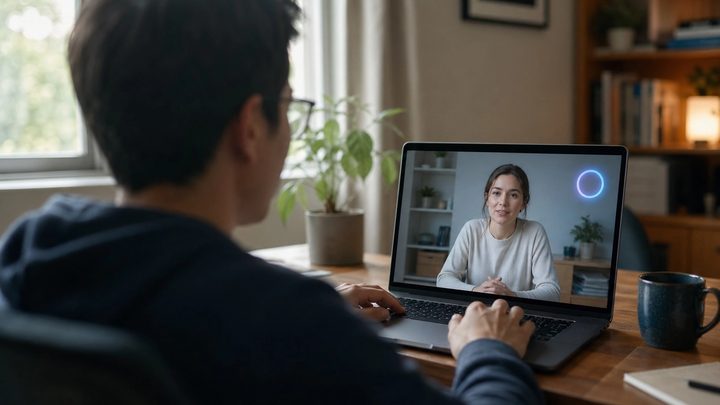
Hiring software developers has always been hard, but in 2026, it has become a battle against automation. With the rise of "interview co-pilots" (tools that listen to your questions and feed answers to candidates in real-time) recruiters are facing a new crisis: AI interview fraud.
The fastest way to tell if a candidate is using AI in your interview is to watch for three signals: a consistent 3 to 5 second silence before every answer, "scanning" eye movement that reads left to right instead of focusing on you, and answers that sound like documentation instead of conversation. None of these are conclusive on their own. The reliable defence is automated screening that measures response time variation and candidate answer similarity to a known AI baseline before you ever get on a call.
Here is how to spot the signs manually, why manual detection wastes most of your time, and how to catch interview cheating before it eats your calendar.
What 2026 interview cheating actually looks like
The market for interview co-pilots has expanded fast. The most common setups in 2026 include real-time transcription overlays that read your question and display an answer in a translucent window, audio whisper agents that feed answers through an earpiece, and second-device setups where a phone or tablet runs an LLM just out of camera frame. Most candidates who cheat use a combination.
What ties all of these together is latency. Every co-pilot has to listen, transcribe, prompt, generate, and either display or speak the answer. Even the fastest setups introduce a measurable delay between the end of your question and the start of the candidate’s response. That delay is the thing you want to anchor on.
The Telltale Signs: What to Look For
The three most common signs of a candidate using an AI interview co-pilot are "scanning" eye movements as they read hidden text, consistent 3-5 second delays before answering while the AI generates a response, and repetitively echoing your questions to buy the software more time.
While interview co-pilots are getting faster, they still introduce friction into a conversation. If you are running a standard video or phone interview, watch for these three major red flags.
1. The "Scanning" Eye Movement
When we think, our eyes might drift up or to the side, but they usually return to the listener. When a candidate is reading an AI-generated script, their eyes often move in a "scanning" pattern, left-to-right, line-by-line. Watch for candidates who seem to be reading invisible teleprompters or looking intently at a specific part of their screen that isn't the camera.
2. The "Processing" Delay
One of the most reliable indicators is candidate response time analysis. AI models are fast, but they aren't instant. There is a "lag loop":
- You ask the question.
- The tool transcribes audio to text.
- The LLM generates an answer.
- The candidate reads it.
This creates an unnatural silence immediately after you finish speaking. If a candidate consistently takes 3-5 seconds of dead silence before answering every question, even simple ones, they might be waiting for their co-pilot to load.
3. The "Echo" Tactic
To buy extra time for the AI to generate a response, candidates often repeat the question back to you.
- Recruiter: "Can you explain the difference between TCP and UDP?"
- Candidate: "The difference between TCP and UDP... that is a great question. The difference is..."
While some repetition is normal, doing it methodically for every technical question is a common stalling tactic used to mask the latency of interview co-pilots.
What our screening data shows
EvoHire runs every interview through three behavioural metrics: average response time, response time variation (standard deviation across all answers), and candidate answer similarity to a canonical AI-generated answer for the same question. Candidates flagged for likely AI assistance tend to share a specific signature.
- Response time variation collapses. A natural interview has a wide standard deviation. Easy questions get answered quickly, hard questions take longer. AI-assisted candidates show unnaturally flat variation because the LLM takes roughly the same time to generate a 3 sentence answer regardless of difficulty.
- Vocabulary tightens. Real engineers say "yeah", "kind of", "I mean", trail off, and circle back. LLM-generated answers omit those entirely and tend to use textbook connectors like "furthermore" and "in conclusion".
- Answer similarity to a baseline LLM response runs high. Our system flags pairs where the candidate’s answer closely matches what a public LLM would produce for the same question. When this happens across multiple questions in one interview, the probability of unassisted answers drops fast.
Any one of these on its own is noise. Two together is a yellow flag. All three across an interview is the signature you actually care about.
Why Manual Detection Fails
Relying on human interviewers to manually detect AI cheating is inefficient because the realization usually happens 15 minutes into a call. This traps recruiters in a sunk cost scenario, wasting valuable time and mental energy on fraudulent candidates instead of assessing legitimate talent.
Here is the hard truth: even if you are an expert at spotting these signs, you have already lost. By the time you notice a candidate is using AI interview fraud software, you are typically deep into the call. You cannot easily hang up without risking a negative Glassdoor review, so you have to sit through the rest of the interview, wasting 30+ minutes of your day.
How does EvoHire automatically detect AI interview fraud?
EvoHire prevents AI interview cheating by acting as an automated first line of defense. Our AI agent conducts the initial screening and detects fraud by analyzing hidden metrics that humans miss, including precise response time deviations, unnatural lexical patterns, and candidate answer similarity.
The most effective way to prevent interview co-pilots in coding tests and screens is to remove the human element from the first round entirely.
EvoHire acts as your AI defence layer. Instead of you spending hours on the phone, EvoHire’s AI agent calls the candidate for you. It conducts a rigorous, conversational technical interview based on the specific skills you need, from junior to senior levels.
How It Stops Cheating
Because EvoHire is a machine talking to a human, it can measure metrics that humans miss.
- Response Time Deviation: It tracks exactly how long a candidate takes to answer. Consistent, unnatural delays are flagged immediately in the report.
- Lexical Analysis: EvoHire processes the language and vocabulary of every answer. This can catch even those who try to paraphrase their responses to avoid detection.
- Audio & Transcript Analysis: You get a full video recording and transcript. If a candidate’s answers are technically perfect but functionally robotic, you can spot it in seconds by watching the interview rather than sitting through the call.
The Result?
You wake up to a dashboard of completed interviews. You open a report, see a "High Response Delay" warning, and simply archive the candidate. No awkward confrontations, no wasted afternoons. You only spend time on candidates who have already proven they can speak naturally and competently.
Frequently asked questions
How much lag do interview co-pilots add in 2026?
Most consumer-grade co-pilots add 2 to 5 seconds of latency between the end of your question and the start of the candidate’s spoken answer. Higher-end real-time tools have closed that gap to 1 to 2 seconds, but they still struggle to remove it entirely on clarifying follow-ups and interrupts. The shorter the gap, the more important behavioural and lexical signals become.
Can a candidate beat detection by paraphrasing the AI’s answer?
Some try. The problem is that paraphrasing an answer in real time, while listening to a fresh AI response, produces a recognisable cognitive overhead. The candidate either falls behind, drops technical detail, or leaves long pauses mid-answer. The behavioural signal still shows up, just differently.
Are take-home coding tests still useful?
Not for scoring on correctness alone. AI solves them. Take-homes are still useful as a conversation starter. Have the candidate walk through their solution out loud, ask why they picked a specific data structure, and ask them to extend it live. The conversation is much harder to fake than the code.
What about the legal risk of flagging a candidate for suspected AI use?
Standard practice is not to accuse. Use AI signals to deprioritise rather than auto-reject, and surface flagged interviews to a human hiring manager for the final call. EvoHire flags suspect interviews for human review rather than rejecting candidates outright. For jurisdiction-specific employment guidance, talk to your counsel.
Ready to screen candidates without the headache?
Stop letting interview co-pilots steal your time.
Try EvoHire’s Free Plan to conduct 5 free AI interviews this month, or start a 7-day free trial of our Pro plan to scale your hiring today.