

In this article
It used to be easy. You gave a candidate a coding problem, they solved it, and you hired them.
Then ChatGPT arrived. Suddenly, take-home tests became optional. A candidate could copy-paste a prompt and get a perfect solution in seconds. So, recruiters adapted. We moved to live coding sessions and Zoom interviews. We thought we were safe.
We were wrong.
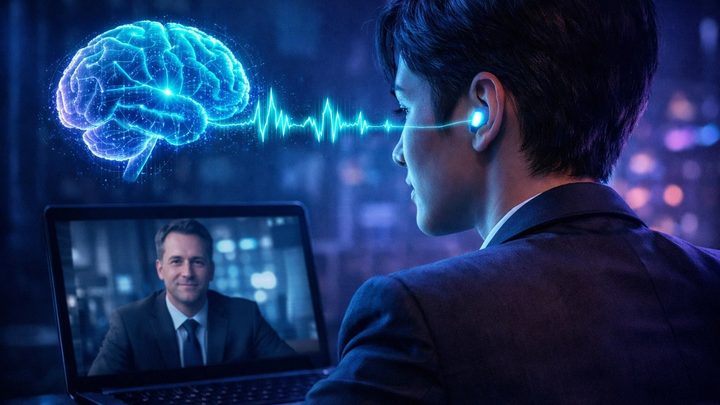
The new challenge isn't just about candidates using AI to solve async tests. It's about candidates using "AI Copilots" (real-time overlays and audio assistants) during live interviews. They are feeding your questions into a model and reading the answers back to you, often without you noticing.
If you are relying on standard technical screening tools, you might be hiring a prompter, not a developer. Here is how the landscape has shifted and how you can spot the difference.
The Mechanics of Modern Interview Cheating
Cheating has evolved from simple Googling to sophisticated, real-time assistance. Candidates now use browser extensions that listen to system audio (your voice), transcribe the question, send it to an LLM, and display the answer on their screen.
The scary part? It happens instantly. The latency of modern models is so low that a candidate can read an AI-generated response with almost natural timing.
Red Flags: How to Spot an AI Copilot
You don't need invasive spyware to catch this. You just need to pay attention to specific behavioral cues that AI struggles to mask.
1. The "Processing" Pause Even the fastest models have a slight delay. If a candidate consistently pauses for 2-3 seconds before answering simple conceptual questions—or if their pause time is mechanically consistent regardless of difficulty—they might be waiting for text to generate.
2. The Shift in Tone Pay attention to the vocabulary. Does the candidate switch from casual, conversational English to highly structured, textbook definitions? AI output often sounds like documentation. If a candidate sounds like they are reading a Wikipedia article, they probably are.
3. Lack of Reasoning This is the biggest tell. An AI can give you the correct code, but it rarely explains the why effectively in real-time. If you ask a candidate to explain a specific design choice in their code and they stumble or give a generic answer, it’s a sign they didn't write it themselves.
Why Traditional Coding Assessments Fail
Most ai coding assessment platforms focus on output: Did the code run? Did it pass the test cases?
This binary approach is obsolete. In 2026, valid syntax is free. The value of an engineer isn't in syntax generation but in problem-solving and architectural thinking. If your technical screening tools only measure code correctness, they are measuring how well a candidate can use a tool like GitHub Copilot, not how well they understand the problem. See our comparison of technical screening tools for AI-era hiring.
The Solution: Behavioral & Latency Analysis
To fix this, we need to stop looking at what the answer is and start looking at how it was delivered.
This is where EvoHire’s approach differs from traditional platforms. Instead of just grading code, we analyze the interview dynamics.
- Response Latency: We track the time between the question ending and the answer beginning. Abnormal patterns or uniform delays are flagged.
- Response Variation: Humans vary their speed. We speak quickly when we are confident and slowly when we are thinking. A flat, uniform speaking rate is a strong indicator of reading a script.
- Voice-First Screening: By using an AI agent to conduct a verbal interview via phone or audio, we remove the visual crutch. It is much harder to read an AI-generated script naturally over the phone than it is to paste code into a text editor.
Hiring for the Future
There is nothing wrong with developers using AI. In fact, you want engineers who know how to leverage these tools. But you need to know they can function without them.
The goal isn't to ban AI. It is to ensure that the human behind the screen actually understands the code they are shipping. If they can't explain it to an AI interviewer, they certainly won't be able to explain it to your team.