

In this article
Automated Interviews Are No Longer Just for Code
For years, the biggest bottleneck in technical hiring was validating hard skills. Could the candidate actually write the code? Tools like EvoHire solved this by offering automated technical screening that ranks candidates based on raw engineering ability.
But every hiring manager knows that technical skills are only half the battle.
You’ve likely interviewed a candidate who aced the coding challenge but failed the "vibe check," or worse—you spent 45 minutes on a Zoom call only to realize their notice period or salary expectations didn't match your needs.
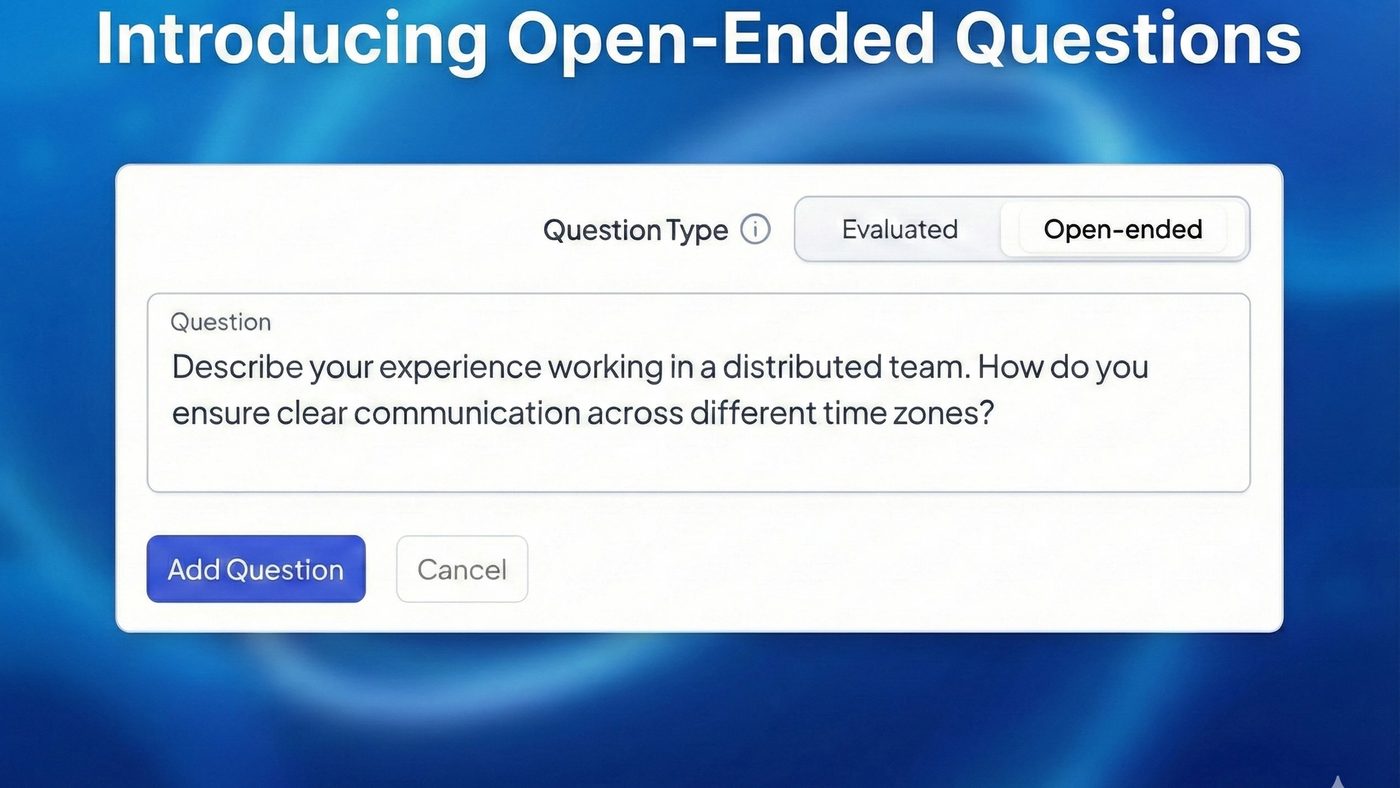
Today, we are bridging that gap. EvoHire is introducing Open-Ended Questions, transforming our platform from a coding assessment tool into a comprehensive AI recruiting software capable of handling the entire initial screen—technical, behavioral, and logistical.
What Are Open-Ended Questions?
Previously, automated interviews were binary: the code runs, or it doesn't. With our new feature, you can now inject free-text, open-ended questions into your interview flow.
This allows you to capture the nuance of a human conversation without the scheduling headache. You can now ask:
- Logistical Questions: "What is your current notice period?" or "Are you open to relocation?"
- Behavioral Questions: "Describe a time you disagreed with a product manager. How did you resolve it?"
- Technical Context: "Explain the architecture choice behind your last project."
Why "Hybrid" Automated Screening is Better
Efficiency in hiring isn't just about speed; it's about accuracy. By layering open-ended questions on top of technical challenges, you create a "Hybrid Screening" process.
- Screen for Soft Skills Early Soft skills assessment usually happens in the second or third round. This is expensive. By automating questions about communication style or conflict resolution, you can filter out candidates who aren't a cultural fit before your team invests expensive engineering hours in face-to-face interviews.
- Eliminate "False Positives" A candidate might scrape together a solution to a coding problem using memorized patterns. However, asking them to explain their approach using an open-ended question creates a deeper layer of verification. It proves they understand the why, not just the how.
- Streamline Logistics Nothing kills "Time to Hire" metrics like scheduling conflicts. Automating the "logistics check" (availability, visa status, salary range) ensures that every human interview you take is with a candidate who is actually viable.
How to Use Open-Ended Questions in EvoHire
Getting started is simple. When building your interview template in EvoHire:
- Select your Technical Challenges: Choose the coding problems relevant to the role (e.g., React, Python, SQL).
- Add a "Text Response" Step: Insert your new open-ended questions.
- Review with Context: When reviewing the candidate's report, you will see their code execution results alongside their written answers, giving you a 360-degree view of the applicant.
The Future of AI in Recruitment
As we move toward 2026, the definition of automated interviewing is expanding. It’s no longer about replacing human judgment; it’s about empowering it with better data.
By combining rigorous code testing with flexible, open-ended inquiry, EvoHire helps you hire engineers who are not just great coders, but great teammates.
Ready to upgrade your screening process? Try EvoHire’s new features today (opens in a new tab) and stop compromising on candidate quality.